Mobilna stacja odbioru satelitarnego pasma L z czaszą offsetową na tle stoiska PTMA i publiczności ERC 2026.
Portable L-band satellite ground station and offset dish at the PTMA booth during ERC 2026.
Podczas 12. edycji prestiżowych międzynarodowych zawodów robotycznych European Rover Challenge (ERC 2026), zorganizowanych na terenie Akademii Górniczo-Hutniczej (AGH) w Krakowie, połączyliśmy siły trzech oddziałów Polskiego Towarzystwa Miłośników Astronomii – PTMA Kielce, PTMA Kraków oraz PTMA Andrychów – wraz z projektem RadioAstro. Stworzyliśmy otwartą przestrzeń popularyzacji nauki, w której nowoczesne technologie kosmiczne, radioastronomia, automatyzacja i obserwacje optyczne były dostępne na wyciągnięcie ręki dla tysięcy gości festiwalu.
During the 12th edition of the prestigious international robotics competition European Rover Challenge (ERC 2026) hosted on the AGH University of Krakow campus, we joined forces across three branches of the Polish Society of Amateur Astronomers – PTMA Kielce, PTMA Krakow, and PTMA Andrychow – alongside RadioAstro. Together, we created a comprehensive space outreach pavilion where microwave radio astronomy, live satellite telemetry tracking, robotic smart telescopes, and autonomous instrumentation were demonstrated directly to festival visitors.
Inżynieria Antenowa i Mobilny Tor Radiowy
Antenna Engineering & Portable RF Signal Chain
Sercem stanowiska radiowego była 1.8-metrowa segmentowa czasza paraboliczna Sanwei osadzona na stabilnej podstawie paletowej oraz kompaktowa czasza offsetowa na statywie geodezyjnym. Obie konstrukcje wyposażyliśmy w autorskie promienniki mikrofalowe dedykowane na pasmo 1.7 GHz, zoptymalizowane pod kątem minimalizacji szumów własnych i maksymalnego dopasowania współczynnika F/D.
The core of our RF demonstration was our 1.8-meter segmented Sanwei parabolic dish on a rigid field base, working alongside a compact tripod-mounted offset dish. Both reflectors were outfitted with custom focal feeds and horn illuminators engineered specifically for the 1.7 GHz L-band, balancing illumination taper and minimizing spillover noise.
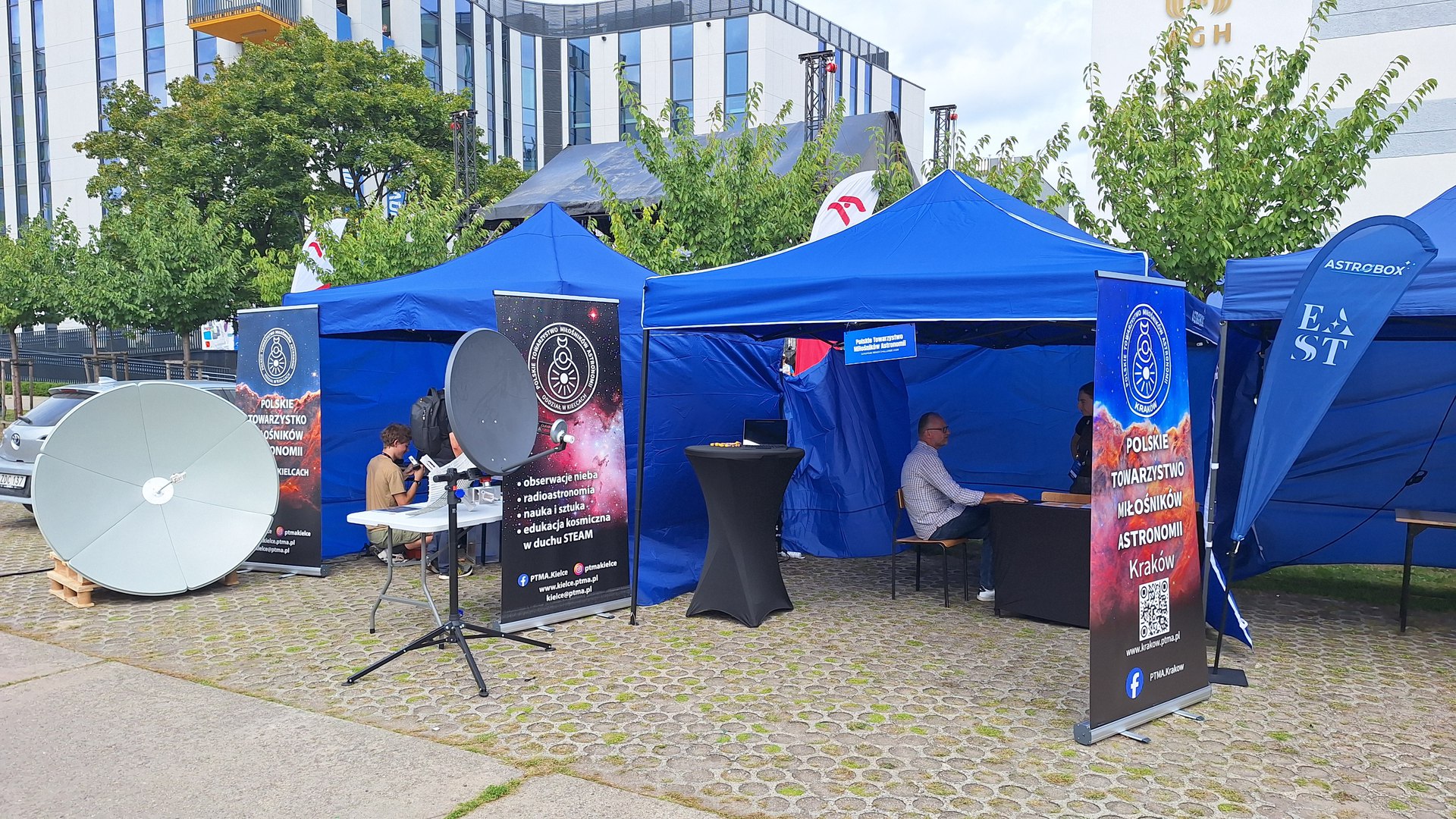
Poranne przygotowania stoiska: namioty PTMA Kielce, Kraków i Andrychów, czasze paraboliczne oraz flaga projektu Astrobox / EASST.
Morning booth setup: PTMA Kielce, Krakow, and Andrychow tents, satellite dishes, and Astrobox / EASST flags.
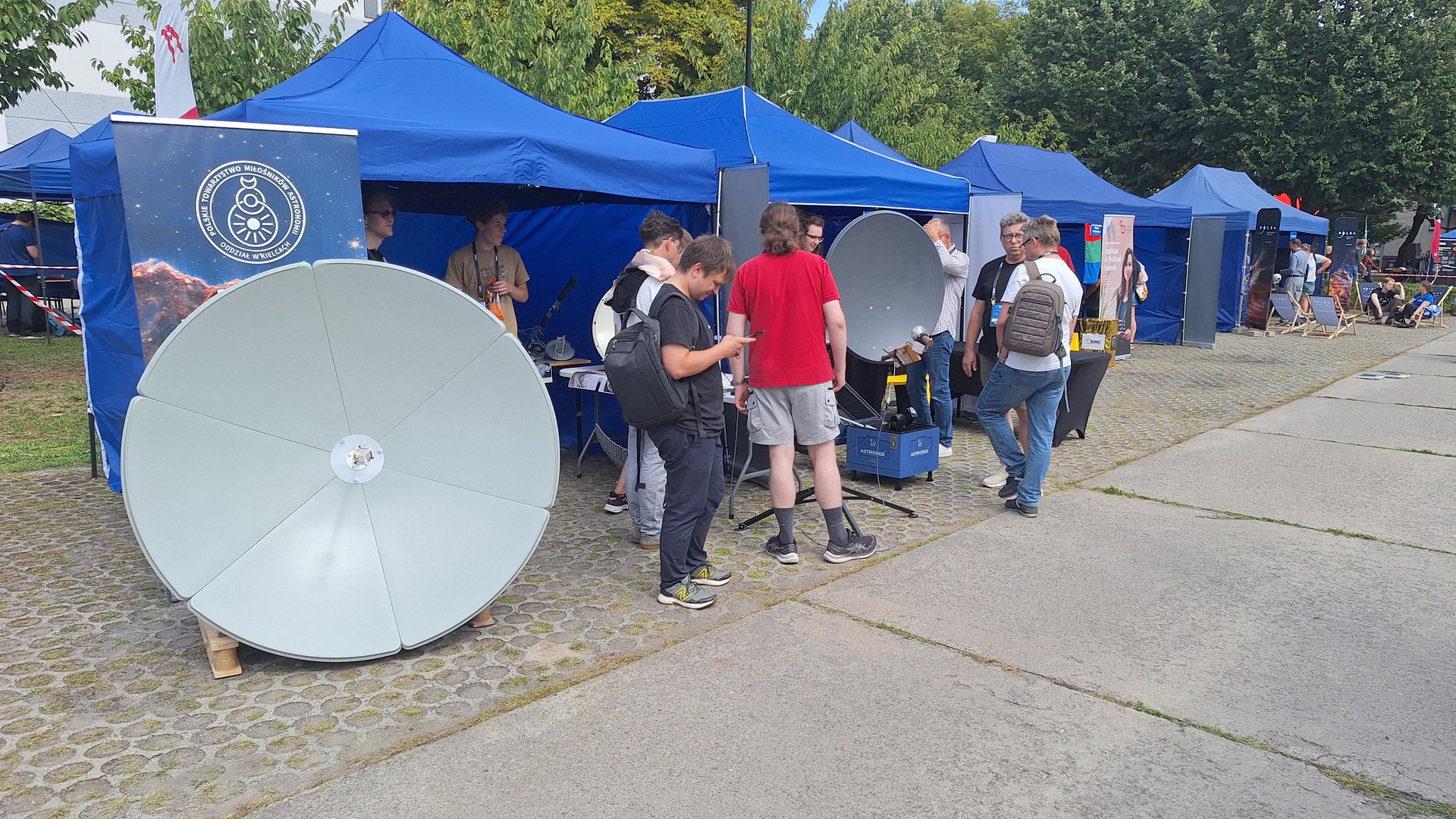
Zestawienie aparatury: 1.8-metrowa czasza Sanwei z centralnym promiennikiem oraz mobilny offset na bazie stacji Astrobox.
Equipment lineup: 1.8m Sanwei prime-focus dish and portable offset dish mounted atop the Astrobox field unit.
Odbiór Satelitarny na Żywo – Od Geostacjonarnych po Polarne
Live Satellite Telemetry Demodulation in SatDump
Prezentacja nasłuchu na żywo przed publicznością wymagała niezawodności toru RF. Wykorzystując odbiorniki SDR oraz wieloplatformowe oprogramowanie SatDump, prowadziliśmy ciągły nasłuch satelitów meteorologicznych i środowiskowych. Zarejestrowaliśmy m.in. zsynchronizowany odbiór strumienia BPSK / CCSDS z satelity geostacjonarnego Elektro-L (RDAS) na częstotliwości 1685.7 MHz ze znakomitym stosunkiem sygnału do szumu przekraczającym 11 dB SNR.
Demonstrating live orbital downlink reception directly before an audience requires absolute RF reliability. Couping low-noise amplifiers and SDR frontends with SatDump, we continuously captured downlinks across LEO and GEO weather craft. We achieved a clean, rock-solid carrier lock on the BPSK / CCSDS downlink of geostationary craft Elektro-L (RDAS) at 1685.7 MHz, sustaining an outstanding SNR above 11 dB.

Ekran SatDumpa podczas pracy na ERC: zsynchronizowana demodulacja BPSK (SNR 11.06 dB) oraz zarejestrowane przeloty Elektro-L, Meteor-M2-4, Aqua, Aura i FengYun-3E.
SatDump interface during ERC operations: locked BPSK constellation (11.06 dB peak SNR) with successfully decoded downlinks from Elektro-L, Meteor-M2-4, Aqua, Aura, and FengYun-3E.
Podczas dwudniowych pokazów w panelu odebranych produktów znalazły się wysokorozdzielcze dane z chińskiego satelity polarnego FengYun-3E, amerykańskich satelitów badawczych NASA Aqua i Aura (instrumenty MODIS, AIRS, CERES) oraz rosyjskiego Meteor-M2-4 (kamera MTVZA-GYa i MSU-GS).
Across both days, our decoded product catalog featured multi-spectral passes from Chinese polar orbiter FengYun-3E, NASA Earth Observing System craft Aqua and Aura (MODIS, AIRS, CERES sensors), and Russian Meteor-M2-4 (MTVZA-GYa and MSU-GS instruments).
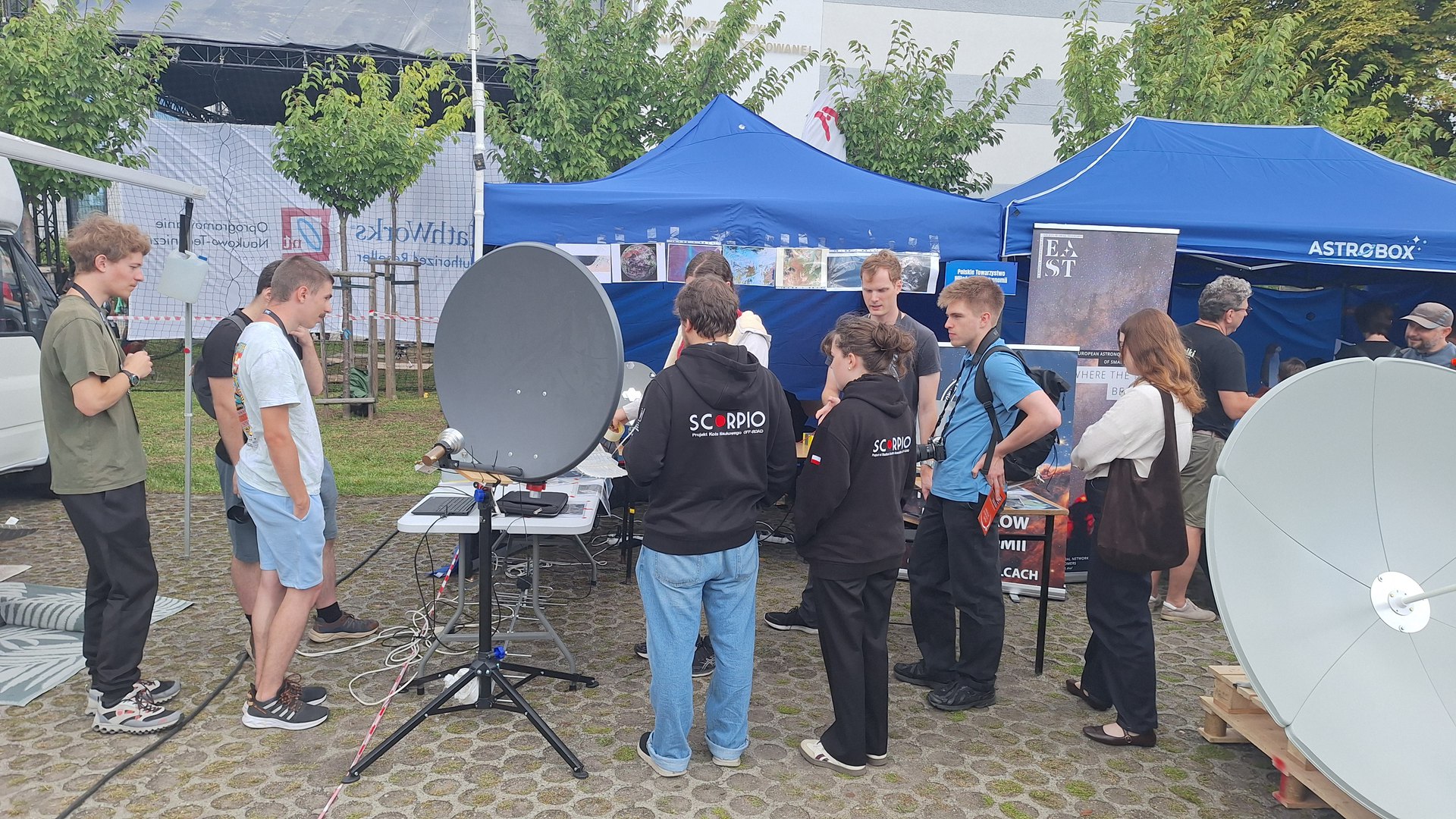
Członkowie zespołu łazika Scorpio oraz odwiedzający dyskutują o odbiorze telemetrii satelitarnej przy czaszy offsetowej.
Members of the Scorpio rover team and festival attendees discuss satellite telemetry reception at our offset dish station.
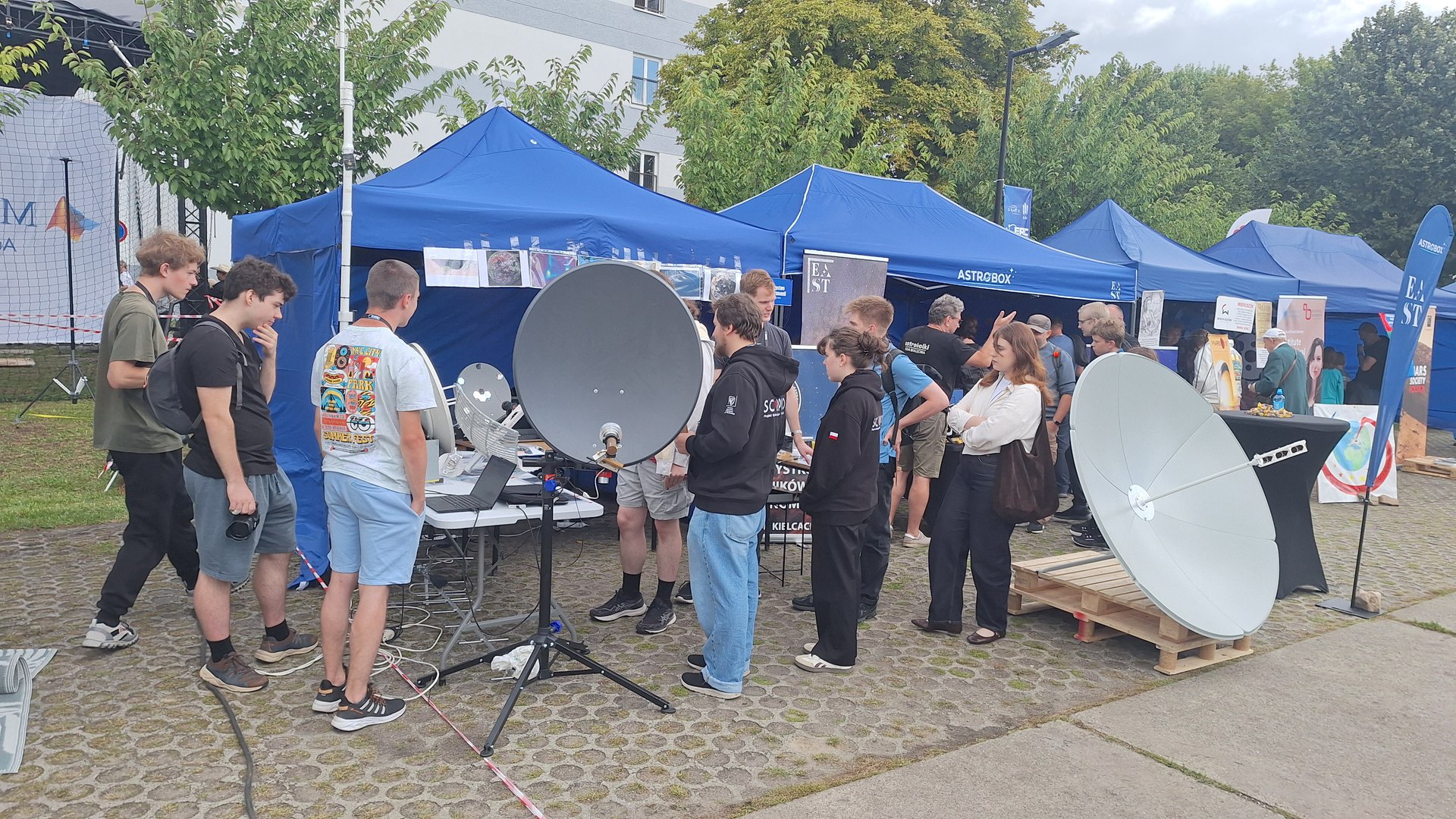
Widok stoiska: uczestnicy oglądają galerię wydruków ze zdjęciami satelitarnymi odebranymi bezpośrednio z orbity.
Booth overview: visitors examine decoded orbital pass imagery prints displayed across the pavilion walls.
Smart Teleskopy, Sieć EASST i Projekt BHTOM
Smart Telescopes, EASST Network & The BHTOM Project
Drugim kluczowym filarem naszego stoiska były nowoczesne smart teleskopy (m.in. ZWO Seestar). Urządzenia te łączą precyzyjną optykę, zintegrowaną matrycę CMOS oraz algorytmy automatycznego stackowania i plate-solvingu w kompaktowej, mobilnej obudowie. Na stoisku prowadziliśmy dzienne obserwacje Słońca (plamy słoneczne, fotosfera) oraz prezentowaliśmy ich potencjał w projektach citizen science.
The second pillar of our presence focused on robotic smart telescopes (including ZWO Seestar). These systems combine precision optics, integrated CMOS sensors, automated plate-solving, and live frame stacking into portable form factors. We performed live daytime solar monitoring (sunspots, photosphere tracking) and demonstrated their scientific utility in citizen science.
Szczególne zainteresowanie wzbudził nasz wkład w sieć EASST (European Astronomical Society of Small Telescopes) oraz globalny program BHTOM (Black Hole Target and Observation Manager). Dzięki automatyzacji małe, rozproszone teleskopy mogą uczestniczyć w profesjonalnych kampaniach fotometrycznych, monitorując zjawiska mikrosoczewkowania grawitacyjnego i aktywność materii opadającej na czarne dziury.
A major talking point was our involvement with the EASST (European Astronomical Society of Small Telescopes) network and the global BHTOM (Black Hole Target and Observation Manager) campaign. Automated small-aperture telescope arrays provide essential high-cadence photometric monitoring for gravitational microlensing transients and black hole accretion phenomena.
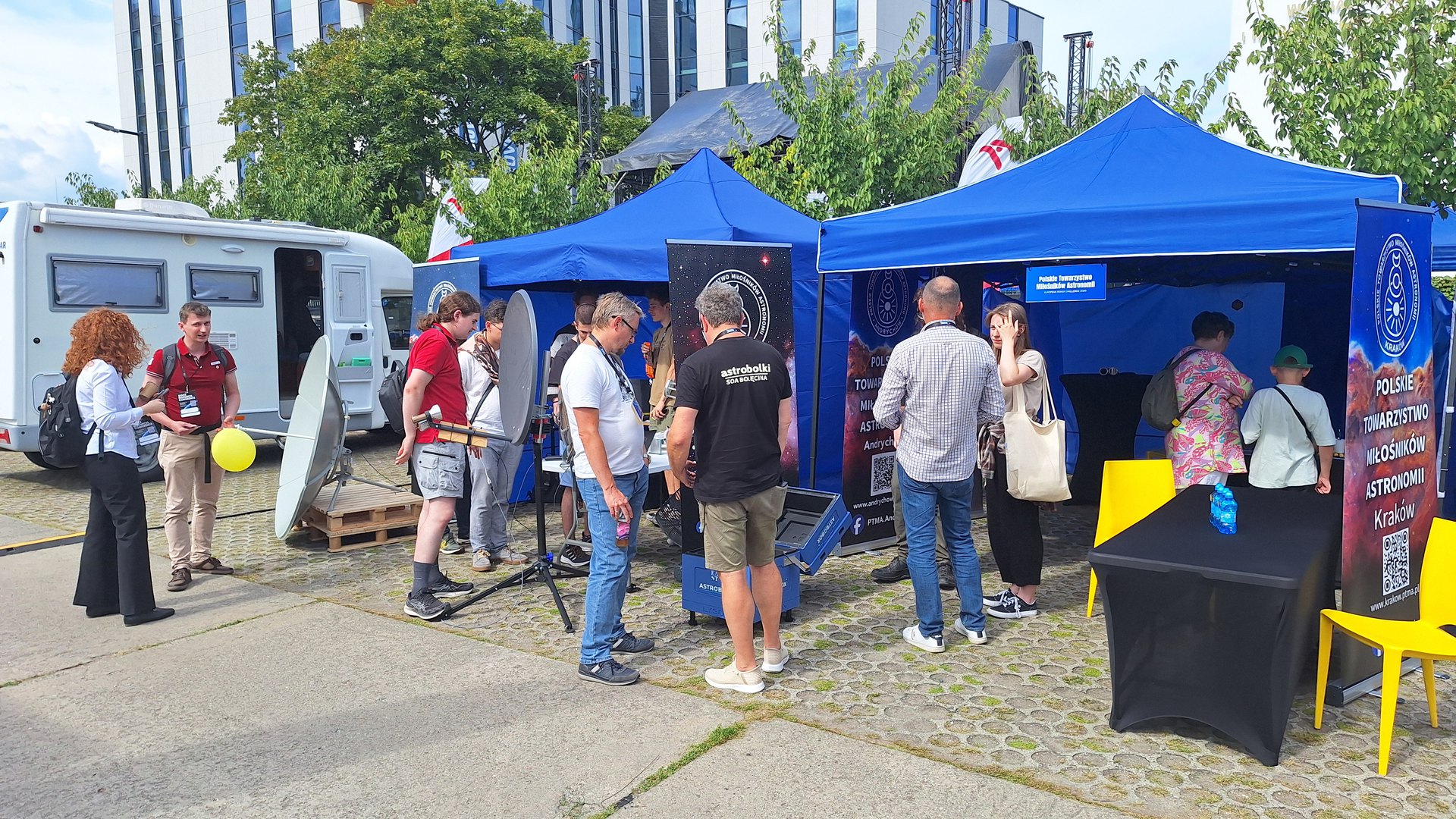
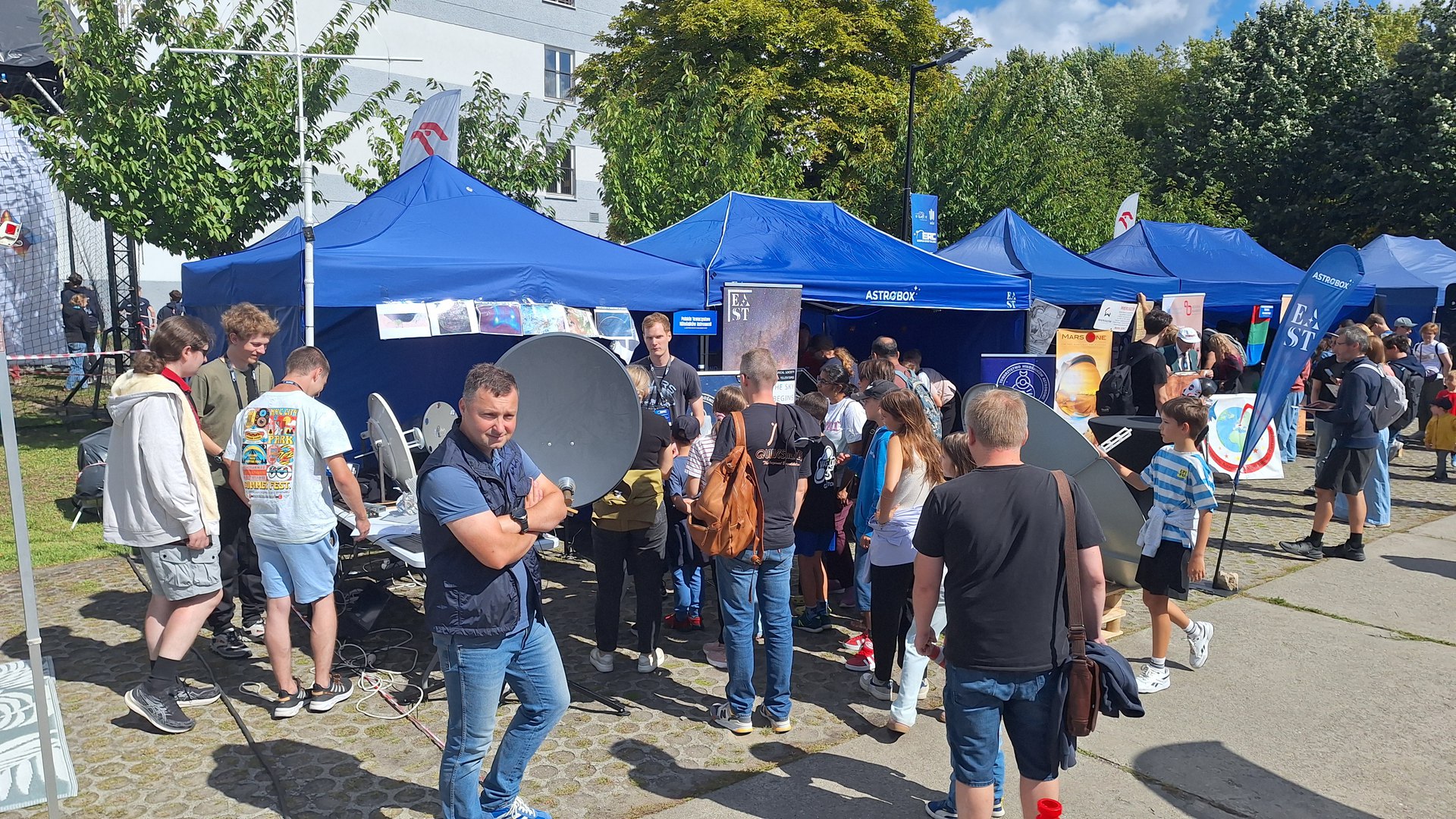
Tłumy odwiedzających stoisko PTMA Andrychów, Kielce i Kraków oraz prezentacja systemu Astrobox do smart teleskopów.
Attendees crowding the PTMA Andrychow, Kielce, and Krakow booth exploring the Astrobox telescope automation station.
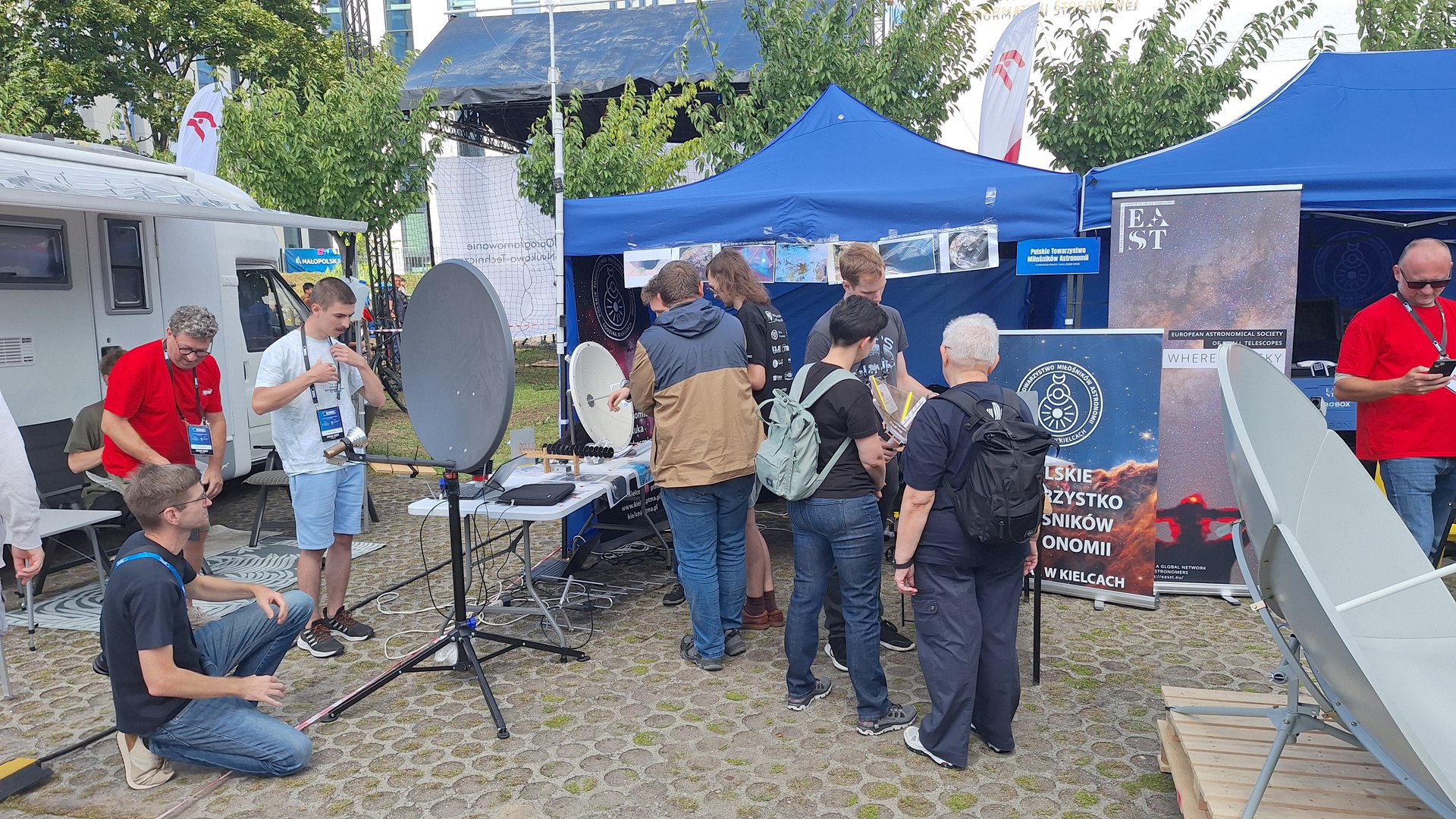
Rozmowy o technice mikrofalowej, promiennikach tubowych i oprogramowaniu SDR z pasjonatami astronautyki.
Technical discussions on microwave feeds, horn antennas, and SDR toolchains with space robotics enthusiasts.
Astrobox – Autonomiczna Stacja Obserwacyjna 24/7
Astrobox – Autonomous 24/7 Observation Station
Jedną z najgorętszych premier na stoisku był Astrobox – dedykowany, w pełni zautomatyzowany system stacyjny pozwalający na całodobową pracę teleskopów Seestar w reżimie 24/7. System wyposażony jest w automatyczną kopułę chroniącą optykę przed warunkami atmosferycznymi, układ zasilania buforowego oraz moduł telemetryczny kontrolujący warunki pogodowe i harmonogram zadań obserwacyjnych bez udziału człowieka.
One of the major highlights was the unveiling of Astrobox – an autonomous base station engineered for continuous, round-the-clock 24/7 robotic operation of Seestar smart telescopes. Featuring an automated motorized weather enclosure, battery backup, and sensor-driven scheduling, Astrobox enables unattended scientific and patrol observations in all conditions.